
Beyond Breakers: A Variety of Attachments Expand What Carriers Can Do
When carrier attachments are mentioned, breakers usually come to mind. But, there’s a world of hydraulic attachments beyond breakers that expand what a skid steer, mini excavator, backhoe or full-size excavator can do on job sites, eliminating the need for separate machines on site.
Hydraulic breakers are great at breaking apart concrete, asphalt, rock and other materials, but not so great when other tasks are needed, like when the ground needs to be compacted, debris needs to be handled, steel needs to be sliced and various other jobs.
Following is a look at some of the most common types of hydraulic attachments that aren’t made for breaking materials:
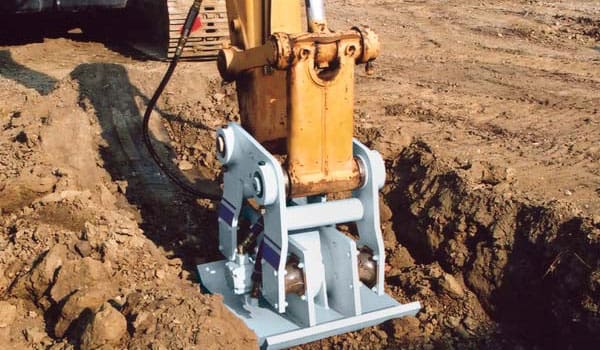
Compactors/Compaction Plates
Compactors—also known as compaction plates—do just as their name implies: they compact soil and gravel. Powered by the carrier’s hydraulics, they are powerful attachments that create high-frequency, rapid vibrations for compacting soil and gravel in areas that are harder to reach, like trenches, slopes and around pipes where self-moving plates or rollers can’t operate. Compacting the ground makes it stable for construction by eliminating air pockets and preventing settling, reaching areas where traditional rollers would be impractical. Compactors are often used for utility and trench work, roadwork and pipeline projects, and general earthwork compaction. They can help eliminate the extra cost involved with a person and walk-behind unit, and the added expense of trench boxes or shoring. They can also be used for setting posts and driving steel sheeting used for retaining walls.
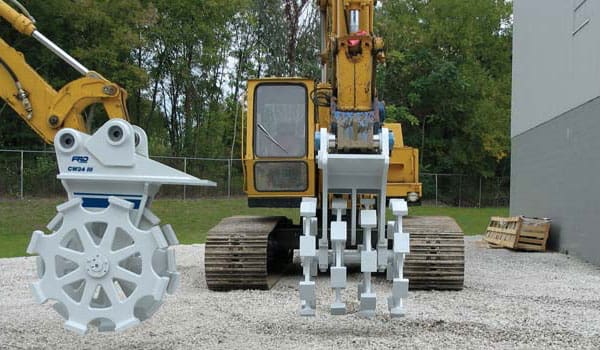
Compaction Wheels
A compaction wheel is designed to compact soil by applying static force and pressure rather than vibration. It consists of a heavy steel wheel—typically with pads, cleats or tapered segments—that is pressed into the ground using the machine’s hydraulic power and operating weight. The carrier machine pushes the wheel against the soil with compaction happening through direct pressure and the kneading action of the wheel. As it rolls, it compresses soil layers and removes air voids in cohesive soils like clay or silty clay. Compaction wheels are typically used in narrow or confined spaces where rollers and rammers can’t operate, such as for trench backfilling around pipes, utilities and foundations. They’re also ideal for jobs requiring controlled compaction close to structures or utilities.
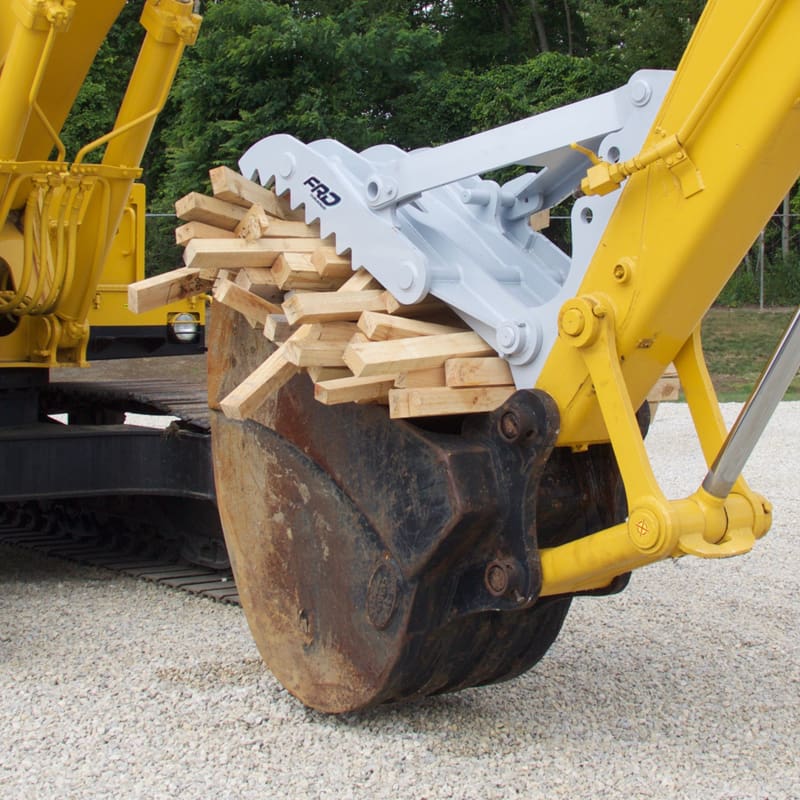
Mechanical Thumbs
They’re called mechanical thumbs, but look more like a claw. They can turn carriers into multi-purpose material handlers, enabling controlled lifting, grabbing and placement of irregular objects—such as handling rocks, boulders and debris, sorting and placing demolition material, or land clearing, brush handling and log placement. Mechanical thumbs are mounted to the stick of a carrier, with the thumb acting like an opposing jaw, becoming a powerful, controllable clamp. The thumb is hydraulically actuated, allowing the operator to open and close it from the cab. When closed, it presses material against the bucket, securing the load.
FRD USA Attachments
Beyond hydraulic breakers, FRD USA provide a complete line of attachments that include compactors, compaction wheels and mechanical thumbs.
- FRD Compactors—for use on a range of equipment—from small and medium excavators or backhoes to medium and large excavators—FRD compactors are designed to work anywhere a boom can reach, whether in trenches, around foundations or on slopes or seawalls. They feature special rubber shock absorbers that protect the carrier’s boom by isolating it from compactor vibrations, as well as hydraulic motors with built-in cross-over check valves to better adapt with today’s carriers and protect the compactor motor. All sizes are built for rugged, reliable performance with hardened steel components to resist the effects of stress, vibration, fatigue and impulse forces.
- FRD Compaction Wheels—FRD Series lll compaction wheels are available in 18″, 24″ and 36″ to accommodate common trench widths. FRD compaction wheels use sealed composite bearings to handle the high workloads today’s excavators or backhoes generate. And because they’re sealed, contamination is reduced extending the service life of the tool.
- FRD Mechanical Thumbs—FRD USA offers a full line of thumbs designed to fit carriers ranging in size from 3,000-120,000 pounds. All tines are fabricated with AR400 steel, which is 38% stronger and 46% harder than commonly used T-1 steel. All pins are machined from hardened steel alloy for low maintenance.